
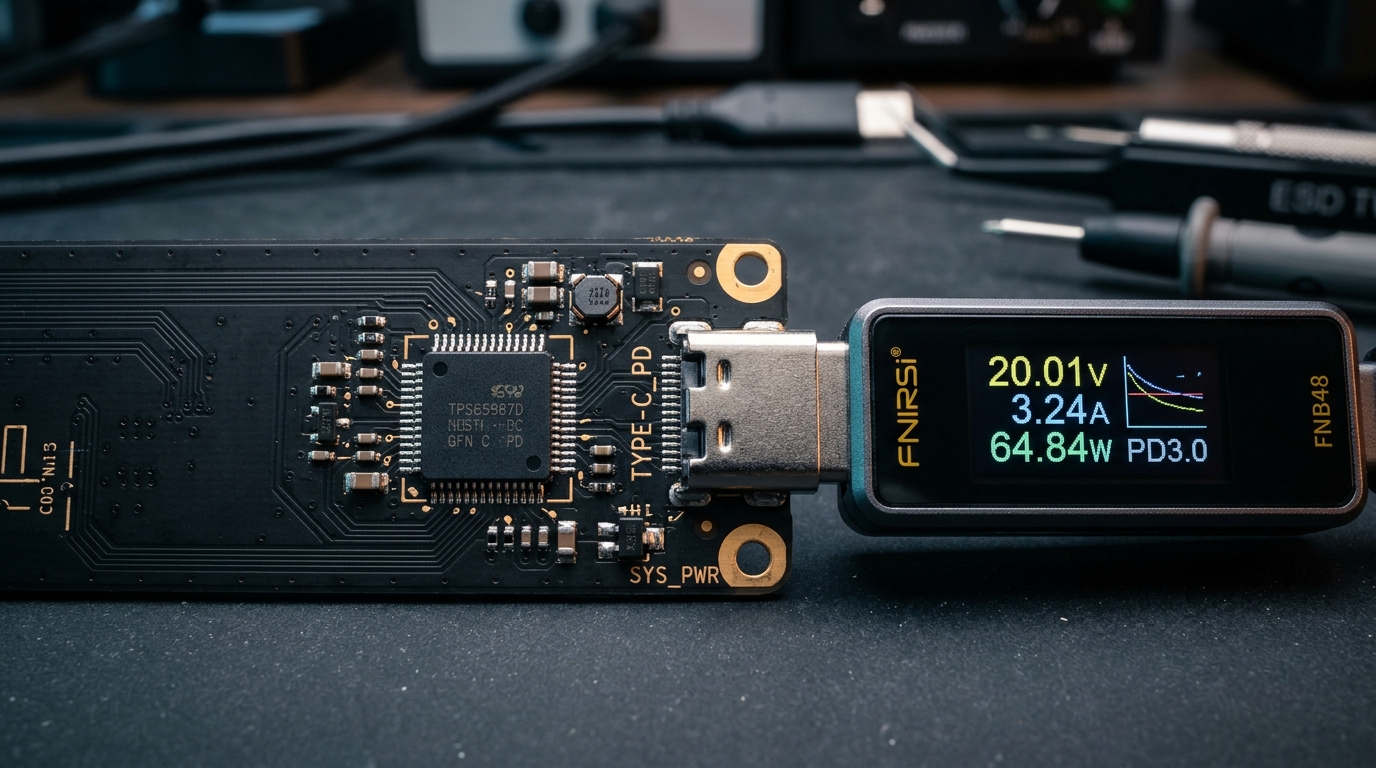
Traditional barrel-jack laptops receive 19V immediately on plug-in. By contrast, modern USB-C Power Delivery (PD) laptops start at 5V and must complete a digital handshake before the charger ever raises VBUS to 20V (3A–5A). A USB-C inline voltage/current meter is therefore an essential bench tool.
1. Reading the USB-C Ammeter: What 5V vs. 20V Tells You
| USB-C Meter Reading | Hardware Meaning | First Circuit to Inspect |
|---|---|---|
| 0V, 0.00A (Meter stays dark) | Dead short on VBUS line or damaged USB-C receptacle pins | Inspect USB-C port pins, TVS protection diodes, and VBUS input MOSFET. |
| 5.0V, 0.00A – 0.05A (Stuck at 5V) | PD controller is powered or failing to negotiate 20V | Check PD controller internal LDOs (3.3V / 1.8V), CC1/CC2 diode readings, and PD SPI ROM. |
| 5.0V → Reboots every 2–3 sec | PD controller booting in a loop due to short on its LDO output or B+ rail | Measure resistance on LDO_3V3, LDO_1V8, and main 20V B+ rail. |
| 20.0V, 0.01A – 0.03A | USB-C PD handshake succeeded! Fault is downstream | Move to main 3.3V/5V standby rails, EC/SIO, and main BIOS. |
2. How USB-C PD Negotiation Works on the Board
- When you plug in a USB-C PD adapter, the charger applies 5V only after sensing 5.1 kΩ pull-down resistors (Rd) on the laptop's
CC1orCC2pin. - The laptop's PD Controller IC (such as TI
TPS65987D,TPS65988, Apple/TICD3215/CD3217, RealtekRTS5455, or Cypress/InfineonCCG5/CCG6) powers up its internal 3.3V and 1.8V LDOs from the 5V VBUS input. - The PD controller reads its firmware (either from a dedicated 1 MB SPI chip or from the EC via I2C), communicates with the charger over
CC1/CC2using BMC encoding, and requests the 20V PDO (Power Data Object). - Once the charger ramps VBUS to 20V, the PD controller turns on the high-voltage VBUS pass MOSFETs, feeding 20V to the laptop's NVDC battery charger IC (e.g.,
ISL9238,ISL9240, orBQ25703A).
3. Top 4 USB-C PD Board Faults
- Shorted CC1 / CC2 ESD Protection Diode: Static discharge or a bent USB-C plug shorts CC1 or CC2 to ground or VBUS. Compare diode-mode readings on CC1 and CC2—both should match closely (~0.45V–0.65V).
- Blown PD Controller IC: Cheap uncertified chargers often spike VBUS above 24V, popping the PD controller's internal LDO. On dual-port laptops (like MacBook Pro or ThinkPad), one shorted PD chip can pull down the shared I2C/LDO bus and prevent all ports from switching to 20V.
- Corrupted PD Controller SPI Flash: Many ThinkPad, Dell XPS, and HP EliteBook boards have a dedicated small
W25Q80chip exclusively for the TITPS65987/TPS65988controller. If corrupted, the laptop stays permanently stuck at 5V. - Worn USB-C Connector: Cracked micro-solder joints on the hidden rear row of a 24-pin USB-C receptacle frequently drop CC communication on one cable orientation while working flipped upside down.
References & Official Documentation
- USB Implementers Forum (USB-IF) — USB Power Delivery (USB PD) Specification
- Texas Instruments — TPS65987D USB Type-C & USB PD Controller Datasheet