
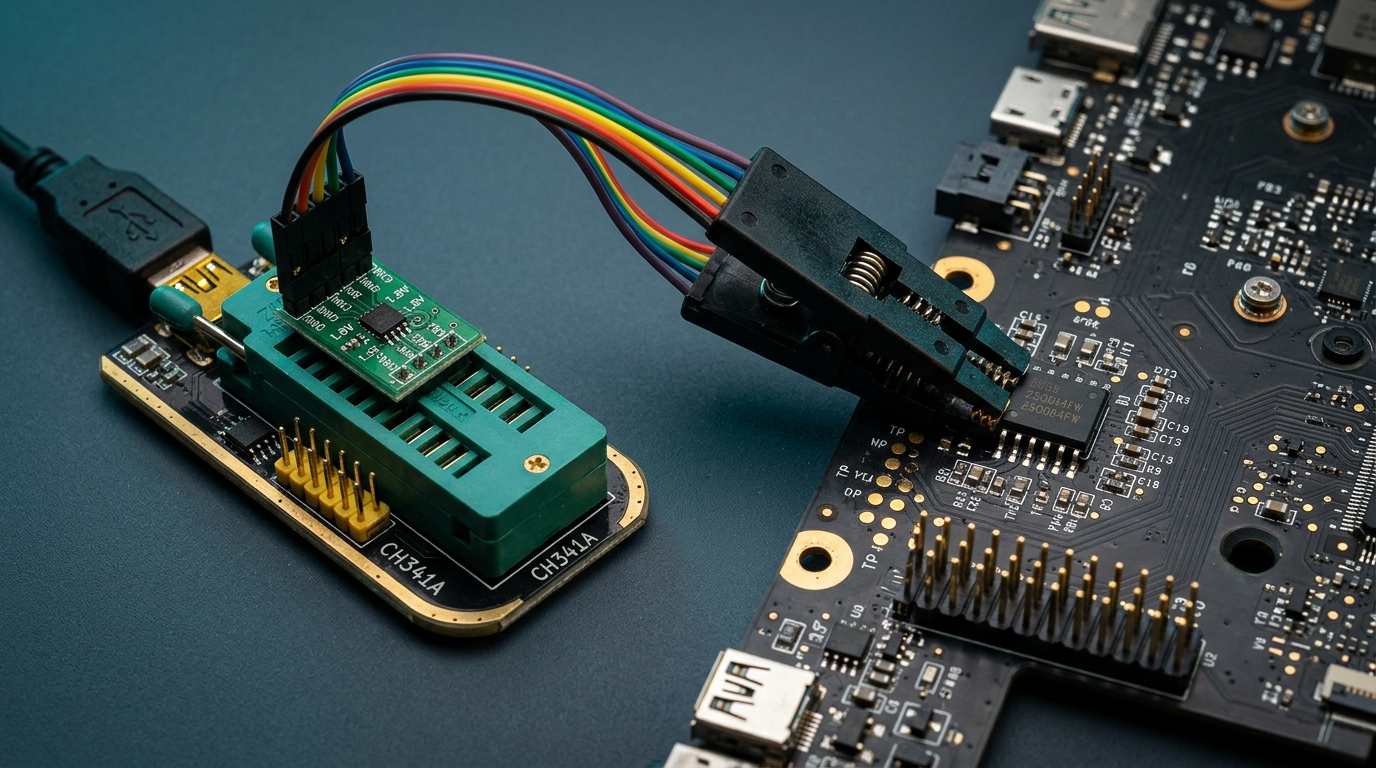
Reprogramming a corrupted SPI NOR flash chip is one of the highest-return board-level repairs in modern laptop service. Yet one of the most common mistakes technicians make—especially when using budget programmers like the black-PCB CH341A—is applying the wrong supply or I/O logic voltage to a low-voltage 1.8V UEFI flash chip.
1. Understanding 3.3V vs. 1.8V SPI Flash Part Numbers
Starting with Intel 6th/7th Gen ultrabooks and becoming nearly universal on 8th–14th Gen Intel and AMD Ryzen platforms, motherboard designers migrated the SPI bus from 3.3V to 1.8V to match modern PCH/SoC I/O banks. Supplying 3.3V (or 5V logic from an unmodified CH341A) to a 1.8V chip can permanently destroy its internal charge pump or cause silent bit-flips during verification.
| Vendor | 3.3V Series | 1.8V Series (Adapter Required) | Common Sizes |
|---|---|---|---|
| Winbond | W25QxxFV, W25QxxJV | W25QxxFW, W25QxxJW | 8 MB (64Mb), 16 MB (128Mb), 32 MB (256Mb) |
| Macronix | MX25Lxx06E, MX25Lxx73F | MX25Uxx35F, MX25Uxx73F | 4 MB, 8 MB, 16 MB, 32 MB |
| GigaDevice | GD25QxxC, GD25BxxC | GD25LQxxC, GD25LBxxE | 8 MB, 16 MB, 32 MB |
| XMC | XM25QHxxA | XM25QUxxA | 8 MB, 16 MB |
2. The Famous CH341A 5V Logic Bug
Standard black-PCB CH341A Mini Programmers power the CH341A IC itself from the USB 5V rail while regulating only the SPI VCC pin to 3.3V. As a result, the CS#, CLK, DI, and DO signal pins output ~4.8V–5.0V. While many 3.3V Winbond chips tolerate this briefly, it violates absolute maximum ratings and frequently corrupts writes or kills 1.8V chips even through weak adapters. Before flashing customer hardware:
- Measure pin 1 (CS#) and pin 8 (VCC) with a multimeter before inserting any chip.
- Either perform the documented CH341A 3.3V rail modification (lifting pin 28 of the CH341A IC and routing it to the AMS1117 3.3V output) or upgrade to a dedicated level-shifting programmer such as RT809F, RT809H, TL866II Plus / T48, or SVOD4.
- Always place a 1.8V level-shifter adapter between the programmer and any
FW/JW/25U/LQ/LB/QUflash IC.
3. Standard 8-Pin SPI Flash Pinout (SOIC-8 / WSON-8)
Whether you are working with a 208-mil SOIC-8 chip or a leadless 6×5mm / 8×6mm WSON-8 package, the JEDEC SPI pin assignment is identical when counting counter-clockwise from the Pin 1 dot:
- Pin 1 — /CS (Chip Select): Active-low select driven by PCH/EC.
- Pin 2 — DO / IO1 (MISO): Serial data output from flash to programmer.
- Pin 3 — /WP / IO2: Hardware write-protect (pulled high during normal programming).
- Pin 4 — GND: Ground reference.
- Pin 5 — DI / IO0 (MOSI): Serial data input from programmer to flash.
- Pin 6 — CLK: Serial clock.
- Pin 7 — /HOLD / /RESET / IO3: Pulled high during standard SPI reads/writes.
- Pin 8 — VCC: Supply voltage (3.3V or 1.8V depending on chip suffix).
4. Safe Bench Flashing Protocol (Zero-Mistake Workflow)
- Desolder rather than clip whenever possible: In-circuit SOIC-8 test clips back-feed the motherboard's 3.3V/1.8V rail, waking up the EC or PCH and causing bus contention that produces corrupted dumps. Removing the chip with hot air (350–380 °C, low airflow, Kapton tape protecting adjacent plastics) takes 30 seconds and guarantees clean reads.
- Dual-read checksum verification: Read the original chip twice into
backup_1.binandbackup_2.bin, then compare their SHA-256 hashes. Never click Erase until both reads are 100% byte-identical. - Verify file size to the exact byte: An 8 MB chip must receive an exact
8,388,608-byte image; a 16 MB chip requires16,777,216bytes. - Verify after programming & clear CMOS: Always run a full Verify pass after writing, clean flux thoroughly with 99% isopropyl alcohol, and disconnect the CMOS coin cell for 30 seconds before first power-on.
References & Official Documentation
- Winbond Electronics — W25Q Serial NOR Flash Family Datasheets (3.3V JV/FV & 1.8V JW/FW)
- Macronix International — MX25L (3V) and MX25U (1.8V) Serial NOR Flash Technical Specifications
- flashrom Project — Open-Source SPI Programmer Hardware Notes & CH341A Documentation
- BIOS Nexus — Interactive SPI Flash 1.8V / 3.3V Chip Identifier Tool